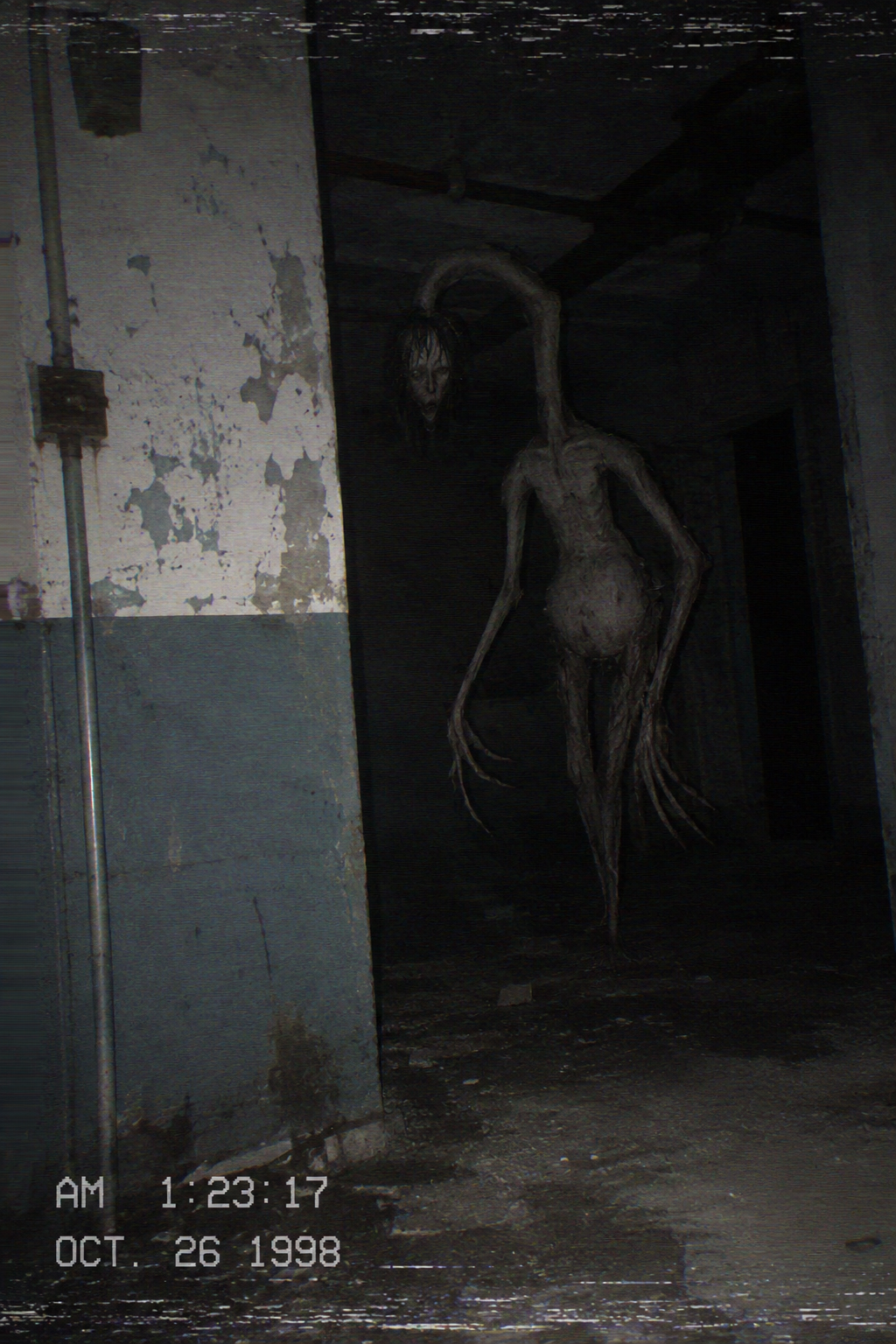
The Woman in the Service Hall
I digitize things for the county. That is the whole of the job, most weeks. Old cassettes, reel-to-reel, floppy disks, the occasional box of microfiche that nobody has looked at since the building it came from was still standing. I take the dying media and I pull the information off it before the information dies with it, and I log it, and I shelve it, and I go home. I am telling you this so you understand I am not the kind of person who believes in what I am about to describe. I deal in degraded signal. I know what a tape does when it fails.
The county records annex is a converted municipal building on the edge of town, three floors and a basement, and it holds the things that do not have anywhere else to go. Police evidence past its retention window. Property records for houses that burned down. Archived emergency calls. Materials pulled out of condemned structures before the wrecking crews move in. It is not a busy place. Most nights there is a security guard on the ground floor and no one else, and the basement where I work is quiet enough to hear the fluorescent lights tick when the motion sensors bring them up.
I was there past midnight because of a storm. The daytime staff had been sent home early when the county issued the flood advisory, and the Bellweather collection was behind schedule, and I had agreed to come in overnight and keep the digitization moving. I did not mind. I prefer the building empty. There is a media room in the basement with one computer, two VHS decks, a small television monitor, metal shelving, and a single door that opens onto the records corridor, and when that door is closed the room is about as isolated a place as exists in the county system.
Bellweather State Hospital closed in 1999. It has been sitting empty on a hill north of the county line ever since, and this year the county finally approved the demolition, which meant that the crews going through it were pulling out anything that might be a record before the building came down. What they pulled came to me in numbered evidence boxes, and I had been working through them for a week. Security footage, mostly, endless gray hours of empty wards and parking lots and nursing stations, the kind of footage that exists only so a court can someday confirm nothing happened.
The boxes were numbered one through fourteen. There was a fifteenth box that had no number and no label.
It was sitting slightly apart from the others on the delivery pallet, and the first thing I noticed about it was that the bottom was wet. A dark waterline had wicked up the cardboard about two inches all the way around. That should not have been possible. The basement is climate-controlled and bone dry, the box had been down there for a day at least, and the other fourteen boxes stacked right beside it were completely dry. I put my hand flat against the bottom of the unmarked box and it came away damp and cold, smelling of standing water, the flat mineral smell of a basement after a flood.
Inside were two VHS cassettes wrapped together in a length of yellow cloth. I know hospital linen when I see it. This was the coarse institutional kind, laundered so many times it had gone soft and translucent, and it had yellowed the way old fabric yellows, except in patches near the center where the discoloration was darker and browner and had soaked in rather than settled on. I unwrapped the tapes, set the cloth aside, and did not think about the patches for a while.
The cassettes were labeled by hand, in ballpoint, in block capitals.
SERVICE HALL, 09/29/98.
SERVICE HALL, 10/26/98.
Folded in with them was a maintenance notice, the triplicate carbon kind that facilities departments used to run on. Most of the ink had bled away, the whole sheet gone to a soft blue nothing, and only one line near the bottom had survived clearly enough to read. It had been written in a heavier hand, pressed hard enough to emboss the paper.
UNDER NO CIRCUMSTANCES SHOULD BOTH RECORDINGS BE VIEWED BY THE SAME EMPLOYEE.
I read it a couple of times. Old institutions are full of this kind of thing, rules that made sense to somebody once and outlived the sense of them, and I had seen stranger notes clipped to stranger boxes. I decided it was the tail end of some liability policy, or a joke between two maintenance men who had been dead for twenty years. I set the notice down next to the yellow cloth. I put the September tape into the left deck, and I brought up the monitor, and I sat down to work.
The footage opened on a corridor.
It was a narrow service hall, the kind that runs behind the parts of a building the public sees, unfinished and functional. Exposed pipes ran along the ceiling. The paint on the cinderblock had gone to a pale institutional green and was flaking off in sheets. The camera was mounted high in one corner, angled down the length of the hall, and at the far end the corridor opened into a doorway, and the doorway opened into black. The timestamp in the corner read 12:32:27 A.M., and under it the date, 09/29/98.
For a long time nothing happened.
I want to be honest about how long, because the length of it was part of what the tape did to me. It was almost seven minutes. Seven minutes of a still hallway, and I sat through all of it, because that is the job, and because when you have watched as much dead footage as I have you develop a kind of patience that is really just the absence of expectation. There was tape hiss. There was the electrical whine that lives in old magnetic media. Somewhere far off in the building the recording had caught a ventilation fan, a low turning drone that never changed. And under all of it, at a slow and even interval, there was a dripping. A single drop, and a pause, and a single drop. It was steady enough that I began waiting for each one.
I had decided the tape was blank, an unused reel that had recorded nothing but an empty hall, when I saw that the doorway at the end was not empty.
There was something standing in it.
It was so thin that I had taken it for one of the pipes. That was the first thing, the thinness. It stood just inside the dark of the doorway, and its edges came clear as my eyes adjusted, and I understood that I was looking at a figure, upright, narrow past the point of starvation. Its shoulders were narrow and high. Its arms hung down along its sides and they hung too far, the hands falling below where the knees would be. The torso was sunken, the ribs suggested even at that distance and that resolution, and yet the abdomen below the ribs was swollen and round and tight, distended in a way that did not match the starvation of the rest of it.
I looked at where the head should be. It took me a while to make sense of what was there, and I am going to try to describe it in the order that I understood it, because the order is the reason it did what it did to me.
From between the high narrow shoulders, where a neck and a head should have risen, there rose instead a thick length of flesh. It came up out of the shoulders and it arched forward, over and down, and it hung in front of the chest, a thick heavy length of it, something poured and left to set while it was still falling. And at the end of it, at the bottom, where it hung down in front of the sternum, there was a face.
It was a woman's face. Late twenties, I would have said, though I was guessing from very little. The hair hung down past it toward the floor. The eyes were open. Across the whole seven minutes and however long I had now been staring, the eyes did not close.
The longer I watched, the less I could hold it in my head as a person with a long neck. It was two bodies made to share one skin, and the sharing had not gone well for either of them.
I stayed where I was, longer than I am proud of. The practical part of me, the part that pulls information off dying tape, was already working, already reaching for the explanation, and the explanation was easy enough. Bad tracking. A smear of mold on the tape. A double exposure from a reused cassette, one image bleeding up through another. I have seen all of those things produce shapes that the eye wants to make into a person. I told myself it was one of those, and I kept watching, because if it was an artifact it would resolve or drift, and I wanted to see it resolve or drift.
Then the face moved.
Not the body. The body stayed exactly as it was, the arms hanging, the swollen abdomen still, a thing standing patient and asleep. Only the face moved, at the end of its length of flesh, and it swayed, a few inches to the left and a few inches back to the right, slow and loose. And while it swayed, the eyes came open wider and the brow drew up and together, and the whole face took on an expression I knew, a human one, the face of a person coming awake somewhere they do not want to be. The body felt none of it. It hung its arms and kept its patient sleeping stillness while the face above it woke up afraid, and the two did not belong to each other at all. It was the most horrible thing I had ever seen a recording do, and I did the thing you do, the reflex, I hit pause.
The image froze. The hallway locked into a single still frame.
And the face kept moving. For one full second after the picture had frozen, after the timestamp had stopped, the face slid a few inches further to the left, and then it stopped too.
I sat back from the desk. My heart was going in a way I did not like. I told myself the deck had held the last live frame a beat longer than the freeze, some quirk of the pause circuit and the tracking, and that this was a known thing that old decks did, which it is not, but I needed it to be. I rewound ten seconds and played it again.
The face was not swaying anymore.
It was looking at the camera. It had been facing down and to the side, toward the floor of the corridor, all through the first playback. Now, in the same stretch of footage, the same timestamp counting up through the same seconds, the face was lifted and turned and pointed straight up the length of the hall at the lens, at me, and the open eyes were open at me.
I rewound again. I did it fast, before I could decide not to.
The doorway was empty. The figure was gone. The hall ran down to a black rectangle with nothing standing in it, seven minutes of nothing, the dripping and the fan and the hiss, and no woman and no body and no hanging face anywhere in the frame.
I stopped the tape.
And out in the records corridor, on the other side of the closed door, something dragged.
It was a slow sound, heavy and wet, something with weight being pulled across the concrete floor of the corridor, and it came from the far end and it moved toward my door and it was not fast. I sat and listened to it come. It reached the door. It stopped. I watched the strip of light under the door and I waited for the shadow of feet to break it, and no shadow came, and nothing pushed against the door, and after a long time I made myself get up and open it.
The corridor was empty. It ran off in both directions under its fluorescent fixtures, and it was empty the whole way. At the far end, where the sound had started, the last light in the row was dark. The others were on. That one was off, and I stood in my doorway and looked at the dark end of the corridor and told myself the motion sensor had timed out, which it had, because nothing was moving down there to keep it lit.
I went back in and I closed the door and I did what I always do when a piece of footage stops making sense. I went looking for the paperwork.
The Bellweather blueprints were already on the computer, digitized before the tapes, and I found the service corridor in the west utility wing, labeled Hall C-4. It was exactly what the footage showed, a narrow spine of a hall behind the wards, and the plan explained what it had been for. It was how they moved the things they did not want carried through the public halls. Laundry, waste, and the bodies of patients who died on the wards, taken down C-4 to the loading dock so the living ones never had to watch the dead ones leave. A renovation report was attached, and it said that on August 14, 1998, C-4 had been bricked shut at both ends and signed off, six weeks before the date on the first tape. There should have been no open doorway in that hall for anything to stand in. There should have been no hall at all, only a length of dead air walled up behind block.
And there should have been no camera. I went into the hospital's camera inventory, the master list of every security camera in the building and its location, and I searched it three times. There was no camera in Hall C-4. There was no camera listed anywhere in the sealed section of the west utility wing. Whatever had recorded seven minutes of that corridor on the twenty-ninth of September, 1998, six weeks after the corridor was sealed, it was not a camera the hospital knew it owned.
Underneath the renovation report, someone had added a line by hand. The handwriting was small and controlled.
CAMERA REQUEST DENIED. DO NOT DOCUMENT HALL C-4.
It was signed. Dr. Miriam Vale, and beneath the name, Hospital Administrator.
I searched the employee directory for her. She was there, a personnel file like any other, hire date and department and a small square photograph in the corner. Dr. Miriam Vale had been reported missing on September 28, 1998. She had not come in that morning and had never been seen again, and the county had eventually closed the file unresolved.
September 28. The day before the first tape.
I looked at the photograph for longer than I meant to. A woman in her late twenties or early thirties, dark hair, a plain administrative portrait against a gray background. It was not a match. I could not have held it up next to the frozen face on the tape and told you they were the same woman. But the shape of the face was there, and the set of the eyes, and the fall of the hair, close enough that my stomach turned over, and I minimized the photograph and sat for a moment with my hand over my mouth.
Then I decided to work, because working is what I do when I do not want to think, and I told myself that isolating the audio was work.
The dripping had bothered me. Not the sound itself but its regularity, too even for water, too patient. I pulled the first recording into the software and brought the audio up out of it, filtered the hiss down, raised the low end where the drip lived, and put the headphones on.
It was not water.
Under the hiss and the fan, at that same slow even interval that I had taken for dripping, there was a voice. It was very quiet and it was very far down in the noise and it was saying one word, over and over, once at each interval where I had heard a drop.
Noah.
I took the headphones off. I sat with them in my lap.
I am aware of how this sounds. I am aware that a person who wants to hear his own name in noise will hear it, that the brain is a machine for finding patterns and will manufacture one out of static if you let it, and that the tape in front of me had been recorded years before I was born by people who could not possibly have known that a county technician named Noah would one day pull the audio off of it in a basement. I told myself all of that. I put the headphones back on to prove it to myself, to hear the random sound land somewhere other than my name.
The voice had changed.
It was not saying Noah anymore. It was saying my mother's name. The same quiet, even, patient voice, down under the fan and the hiss, at every interval where the dripping had been. My mother's name is not a common one. You do not land on it by accident in noise, because you have to already know it to hear it, and the tape could not know it. I sat with the headphones pressing on my ears and listened to a corridor bricked shut and empty for decades say the name my mother was given in a country most of the people I work with could not find on a map. She has been dead for six years. Almost no one living still says that name at all. The tape said it again, patient and certain of being heard, a name spoken toward someone already in the next room.
I ejected the tape.
The television did not go dark.
The cassette was out, in my hand, and the left deck was empty, and the monitor should have dropped to blue or to snow, and instead it was still showing the hallway. The still gray corridor, the pipes, the flaking green, the doorway at the end. It held there on the screen with no tape in the deck to feed it, and while I looked at it, the image was not quite the same as the footage had been. The doorway at the end looked nearer. The angle had not changed and the camera had not moved, but the black rectangle of the doorway sat closer in the frame than it had, the far end of the hall come a few feet up toward the lens.
And the figure was in it again. Standing in the doorway. But its arms were not hanging now. They were raised, one on each side of the door frame, and the long hands had curled around the edges of the opening, the fingers hooked on the brick, and it was leaning its weight forward into its grip in the attitude of something about to pull itself through a gap and into the hall.
I switched the monitor off.
The screen went black, and in the black glass I got the reflection of the room behind me, the shelving, the second deck, the door. And standing near the door, in the reflection, there was something tall. It went up past the top of the frame of the glass. It was there for as long as it took me to register that it was there, and then I was turning, fast, knocking the headphones off my knee, and the room behind me was empty. The door was closed. Nothing stood near it. I was alone in the media room with the blank dead television and the two tapes and the yellow cloth, and my own breathing was very loud.
I should have left. I know that now and I half knew it then. But there was a second tape, and the second tape had a date a month later than the first, and somewhere in the part of me that pulls signal off dying media and needs to know what the signal says, I had already decided I was going to watch it. First I went back to the documents, because I wanted to know what had happened in that hall, and the documents, it turned out, had been hidden.
Most of the references to Hall C-4 had been stripped out of the Bellweather files. I could see the places where they had been, gaps in sequences, a memo numbered 44 followed by a memo numbered 46, that kind of thing. Somebody had gone through these records with intent. But whoever it was had missed one, because folded inside a long dull folder about a boiler malfunction in the east wing, misfiled either by accident or by someone who wanted it found, there was an incident report, and the incident report was about the sealed hall.
Three orderlies had gone into the west utility wing on a night in the autumn of 1998. The report was careful and dry in the way those reports are, and it said that the three of them had entered the sealed section after several staff reported hearing a woman crying behind the brick. They had opened the wall. The report did not say how, only that the seal was breached, and that the three of them had gone in, and that one of them had come back.
The one who came back was named Thomas Grady. He had been found in the laundry room, crawling backward, pushing himself away from the utility wing with his heels and his elbows, and his hands had been badly damaged. The report said the damage was consistent with the patient having pressed his own hands against his eyes with great force over a sustained period. He had been trying to cover his eyes and had not been able to stop.
Grady said one thing over and over while they treated him, and the report recorded it in quotation marks.
It hangs her where the head should be.
He said more later, when he could talk, and a supplementary note recorded that too. He said the thing in the hall did not kill the other two right away. He said it followed. He said it came after them through anything that could hold a reflection and through anything that could hold a recording, that it was in the polished steel of the laundry room and in the black of the switched-off monitors at the nurses' station, and that every time one of them turned and looked at it directly, the neck was shorter than it had been. The face rode higher on the body each time. It was climbing itself. It was getting closer to where a head belongs.
At the bottom of the incident report, someone had written a single line in red ballpoint, gone brown with age, pressed hard.
DO NOT ALLOW THE FACE TO REACH THE SHOULDERS.
I thought about the first tape. I thought about the figure in the doorway, the face hanging low in front of the chest on that first long playback. And I thought about how, by the time I had rewound and looked and rewound again, the face had seemed to ride a little higher against the body than it had at the start, and I had told myself that was the tracking too.
I knew I should stop. I want that on the record. I knew, sitting there with the incident report open and the red line at the bottom of it, that the correct thing to do was to put both tapes back in the wet box and carry the box upstairs and go home and let the day staff decide what to do with all of it in the morning. I knew that.
I also knew that the second tape was dated a month after Dr. Vale disappeared, and that whatever had happened to her and to the two orderlies who did not come back was on it, or near it, and that I was the only person awake in the building and maybe the only person who was ever going to look. So I told myself I would watch it once, all the way through, without pausing and without rewinding, and that this would be safe, because it was the pausing and the rewinding that the first tape had punished.
I put the October tape in the left deck.
The timestamp came up. 1:23:17 A.M., and the date, 10/26/98.
It was the same corridor. The same pipes, the same flaking green cinderblock, the same doorway at the end. But the camera was lower now. On the first tape it had looked down from a high corner. On this one the angle was near the floor, low and tilted slightly up. The camera was no longer mounted at all. Someone had set it down on the concrete, left it running, and backed away.
And the figure was not at the end of the hall anymore. It was close. It stood filling most of the corridor, near enough that the low camera had to look up the length of it, the swollen abdomen and the sunken chest and the high narrow shoulders all rising up out of the frame. The neck came down out of the top of the shoulders and arched forward as it had in September, but it was shorter. There was no question about it being shorter. On the first tape the face had hung down in front of the sternum, low on the chest. Here it hung just below the curve of the shoulders, riding high against the upper body, a foot of climbed distance between where it had been in September and where it was now.
The woman's face had changed too. On the first tape it had been slack, the eyes open and empty, the expression of something asleep with its eyes open. Here the mouth was open and working, shaping a sound the tape did not carry. And the eyes were not pointed at the camera. They were turned up and past it, toward something above and behind the lens, toward whoever had set the camera on the floor and stepped back.
There was a man breathing on the tape. Close to the camera, close to the microphone, ragged and fast, the breathing of someone trying to be quiet and failing. Every few seconds the breathing hitched and caught on something wet at the back of it, and once, distinct under the fan noise, there was the small dry click of a man swallowing against a dry throat, a man who had been crying long enough to run out of the ability to. He was old. I could hear it in the breath, the faint whistle at the top of each one. And under the breathing, low, a voice that was barely a voice at all.
Miriam, I'm sorry.
The figure took a step.
It was one slow step forward, the long foot lifting and coming down, and then the tape distorted, the image tearing into bands of noise and rolling, and it held like that for a second or two, and when it came back the figure was closer. Several feet closer. It had crossed a distance during the distortion that a single step could not have covered, and there had been no movement shown, only the tear in the picture and then the new nearer position, the body now so close to the low camera that the swollen abdomen filled the center of the frame and the face, riding high on its shortened neck, hung angled down toward the lens.
The man behind the camera began to cry. Quietly, helplessly, the sound of someone who has understood something final.
And the face smiled.
It was not a smile. It was the shape of one, made wrong. The corners of the mouth drew back and kept drawing back, wider than the muscles of a face are built to pull them, and there was nothing behind it, no expression driving it, only the mechanical widening, something inside the face working the mouth from within to learn how far it would go. And below it, at the ends of the long hanging arms, the hands had come up, and they were not doing what the mouth was doing. They were folded together at the front of the swollen body, loosely, gently, one thumb moving slow circles over the back of the other hand. It was a soothing gesture. It was the thing you do with your own hands when you are frightened and trying to keep still. The mouth stretched wider and wider toward the camera, and the hands, tender and entirely separate, went on comforting something that was not the mouth, and was not the man behind the camera, and may not have been anything I could name.
I had promised myself I would not pause. I broke the promise, because the creature raised its hand.
It lifted one long arm up toward the camera, and the palm turned toward the lens, and there was something written across the palm in dark fresh lines, and I could not read it at the speed the tape was playing. So I paused, and I leaned in toward the television, close to the glass, to read what was written on its hand.
TURN AROUND, NOAH.
The fluorescent light directly above me went out.
Not a flicker. It went out cleanly and completely, and the media room dropped into the light of the television alone. Then the fixture nearest the door went out. Then, through the wall, muffled, I heard the first fixture in the records corridor go, and then the second, the darkness walking itself down the hall one light at a time, coming toward the room from the far end where the dragging had started, putting out the corridor fixture by fixture in a slow advancing line.
I did not turn around. I kept my eyes on the monitor, because turning around was what the hand had told me to do, and I had just enough left in me to refuse it.
On the screen, the creature was not pointing at the camera anymore. The arm had come down and swung out to the side, and the long finger was extended, and it was pointing off the edge of the frame, out of the television, into the room. It was pointing at the floor beside my chair.
At the top edge of the television, in the faint reflection that a dark screen holds, a single strand of wet hair came down into view. It descended from above the top of the monitor, from above and behind me, hanging into the reflected image of the room, and it swayed a little and hung there, wet and dark against the gray of the reflected shelving.
I closed my eyes.
Something breathed beside my ear. It was close, inches away, at the level of my head, and the breath that came out of it was warm and damp and it smelled of standing water and hospital disinfectant, the flat chemical sweetness of a floor that has been mopped to cover something worse. I kept my eyes closed. I kept them closed so hard that I understood, distantly, what had happened to Thomas Grady's hands.
A woman's voice, very close, very quiet, asked me a question.
Have you seen where they put my body?
I did not answer.
I sat with my eyes shut and my hands gripping the edge of the desk and I did not make a sound, and the voice did not ask again. The room was silent except for the breathing beside my ear, and then the breathing moved away, or stopped, and there was nothing.
Then the second tape started playing again. By itself. I heard the deck engage, the little mechanical seat and catch of it, and the change in the room's sound as the television woke back into the hallway, and over it a new voice, the man from behind the camera, the one who had said Miriam, I'm sorry. He was talking fast now, rushed and uneven, reciting, and I understood that he had recorded this for whoever came next. For me.
He said there were rules.
Do not answer when it uses a familiar voice.
Do not look directly at the hanging face.
If the neck begins lowering, close your eyes.
Keep your eyes closed until the crying stops.
Never let it hear you count.
I kept my eyes shut through all five. I heard each one and I held onto them, and it was on the last one, never let it hear you count, that the counting started.
It came from the records corridor, out beyond the door, and it was a child's voice. Small, and light, and pitched low to the floor, a child lying down or crouched at the bottom of a wall.
Five.
I did not open my eyes. I turned in my chair, blind, toward where I knew the door was.
Four.
The voice was closer. It had come in under the door, or through it. It was in the room now, down near the floor, near the baseboard.
Three.
I reached out with my eyes shut for the lock on the door, for the deadbolt I knew was there, meaning to throw it, and before my fingers found it, the handle turned. On its own, under my reaching hand, the mechanism moved.
Two.
The television burst into static. I heard it, the sudden wall of white noise, loud in the dark room.
And the woman's voice, right beside me again, at my ear, quiet and almost kind, finished the count for the child.
One.
Everything went silent.
I do not know how long I kept my eyes closed. Minutes. The silence held, complete, no breathing and no counting and no static, and I sat in it with my eyes shut until the not-knowing became worse than anything I might see, and I opened them.
The lights were on. All of them, the fixture above me and the one by the door, humming their flat white hum with no sign they had ever gone out. The media room was empty. The television showed blue static, the tape run all the way to its end and clicked off. The two cassettes sat where I had left them. The yellow cloth was on the desk.
I got up on legs that did not want to hold me and I checked the room, because I needed to check it, because the practical part of me had to confirm what it already knew. I looked under the desk. I looked behind the metal shelving, in the gap between it and the wall. There was nothing. The room was a small basement media room with one door and no windows and nothing in it but me and the equipment and the tapes.
I decided I was done, and not only for the night. I would leave the tapes on the desk exactly where they were, and I would go upstairs, and in the morning I would tell Janice that the unmarked box needed to go to someone above my pay grade, someone who could decide what it was and what to do with it, and I would never put either of those cassettes into a deck again.
I opened the door onto a records corridor that was entirely normal, lit end to end, empty and quiet. I stepped out and I started toward the stairwell at the far end, and behind me, in the room I had just left, the VHS deck began to rewind.
I heard it start. The high mechanical whir of the tape spooling backward, winding the second recording back toward its beginning. I had not touched it. I stood in the corridor with my back to the open door and I listened to it rewind, and I did not go back to stop it, and I made myself keep walking.
The sound followed me. That is the part I cannot explain and will not try to. I walked the length of the corridor and up the stairwell to the ground floor, and the whir of the rewinding tape came with me, not fading with distance as a basement sound should, but staying level, staying close, traveling with me through the walls of the building, the tape rewinding in every room I passed at once.
The security guard was not at his desk on the ground floor. I did not look for him very hard. I crossed the lobby and I pushed out through the front doors into the storm, into hard cold rain coming down in sheets across the parking lot, and I got my phone out and I called Janice Holloway, my supervisor, because I did not know what else to do and I needed to hear a person who was not on a tape.
She answered on the fourth ring, and she was confused before I had finished a sentence. I told her I was at the annex, that I had been working the Bellweather collection overnight, that something was wrong with the tapes, and she stopped me there. She asked me what I meant, the Bellweather collection. I said the tapes, the boxes, the ones the demolition crew pulled. There was a pause on her end, rain roaring around me, and she said that the Bellweather materials had not arrived. That the demolition crew had only gone into the hospital that afternoon, for the first time, to begin the survey. That nothing had been removed from the property yet. That there was no collection at the annex, because there was nothing to collect until the crew cleared the building, which would take weeks.
I turned around and looked back at the annex.
The basement is below grade, but the top foot of the basement windows sits above the ground, narrow rectangles of glass at the base of the wall, and one of them, the one that belonged to the media room, was lit. And there was a figure behind it. It was too tall for the room. I knew the ceiling height of that basement, I had sat under it all night, and the figure filled the window from the bottom of the glass to the top and was bent to do it, its body going up out of the frame, and the neck came down from above, out of the top of the window, curving down through the light, and the face was pressed flat against the inside of the glass. The hair was spread against it, wet, and the open eyes were turned up toward me across the parking lot in the rain.
Janice was still talking, asking me through the phone what tapes I had watched, what was written on them. I told her the dates, September twenty-ninth and October twenty-sixth.
She stopped talking.
The rain came down. I stood in it and waited, and after a long time she said, in a careful voice, that those two dates had come up that afternoon, in the demolition briefing. That the survey crew had gone into the west utility wing and found a section of hall that had been bricked off at both ends decades ago, and that when they got close to the brick they had found dates carved into it. Carved over and over, hundreds of times, the report said, scored into the mortar and into the faces of the blocks by something that had been on the sealed side of the wall.
September twenty-ninth. October twenty-sixth.
There were no tapes, Janice said. The crew had not found any tapes. Nothing had been carried out of that building. Whatever I had been watching in that basement, it had not come from Bellweather, because nothing had come from Bellweather yet.
I looked back at the window. It was empty. The media room was lit and ordinary and there was nothing behind the glass, and for a moment the size of my own relief almost put me on the ground.
Then I got to my car, and I saw what was on the seat.
It was a VHS cassette, resting in the center of the driver's seat. My car was locked. It had been locked the whole night, out here in the lot in the rain, and the windows were up and the doors were sealed and there was a cassette sitting on the driver's seat that had not been there when I parked. I opened the door and the interior light came on and I picked it up, and it was warm. Not room temperature. Warm, the warmth of something recently held, or recently played.
The label was handwritten in fresh black ink that had not fully dried, and it smudged under my thumb.
PARKING LOT, CURRENT DATE.
Under the words was a timestamp. It was tonight's date, and a time, and the time was three minutes from now.
I looked back at the annex one more time. The basement window was dark and empty. The building stood in the rain like any building.
My phone rang in my hand. I still had it out from the call with Janice, and it lit up and rang, and I looked at the caller ID, and the number on the screen was my own. My own cell number, calling me, from somewhere, while I stood in the parking lot holding a warm tape.
I answered it. I do not know why. I put it to my ear and I did not say anything, and on the other end of the line I could hear breathing. Slow, even breathing, and it was mine. I know my own breathing. It was me, on the other end of my own number, breathing in the slow even rhythm of someone sitting very still.
And under the breathing, in the background of the call, faint and mechanical, a VHS tape was playing. I could hear the hiss of it, the hall-sound of it, the fan and the drip. And over that sound, my own voice, recorded, quiet, said one thing into the call.
Don't look above the car.